What counts as a hypopnea on a sleep study?
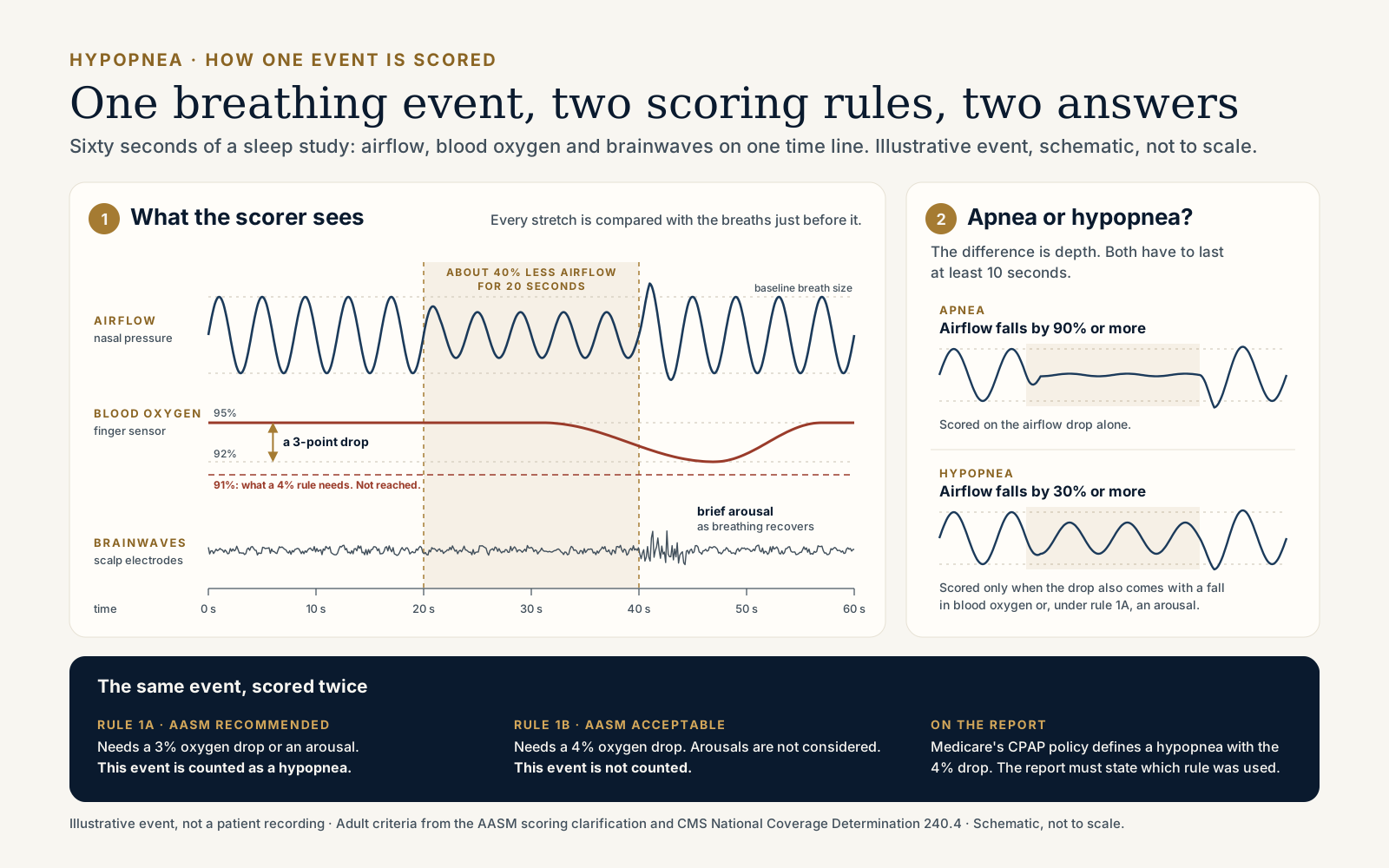
Three things have to be true at once: airflow falls by at least 30 percent, the drop lasts at least 10 seconds, and it comes with a drop in blood oxygen or, under the recommended rule, an arousal.
During a sleep study a thin nasal cannula records the pressure of each breath, a clip on the finger records blood oxygen, belts around the chest and abdomen record breathing effort, and scalp electrodes record sleep and brief awakenings. A scorer compares each stretch of reduced breathing against the breaths just before it. The 2012 rules paper from the American Academy of Sleep Medicine's Sleep Apnea Definitions Task Force, which still underpins adult scoring, recommends scoring a hypopnea when the nasal pressure signal falls by at least 30 percent for at least 10 seconds in association with either a 3 percent or greater oxygen desaturation or an arousal. The consequence matters because shallow breaths on their own are common and mean little. It is the oxygen dip or the fragment of lost sleep that turns a shallow stretch into a scored hypopnea event. The Academy's clarification also names the sensor: nasal pressure on a diagnostic study, the PAP device's own flow signal on a titration study, or an alternative hypopnea sensor when the primary one fails.
Apnea vs hypopnea: what is the difference?
An apnea is a near-complete stop in airflow, a drop of 90 percent or more. A hypopnea is a partial reduction, a drop of 30 percent or more. Both must last at least 10 seconds.
The two events are also measured with different sensors. The 2012 rules paper recommends an oronasal thermal sensor, which detects the warmth of exhaled air, for apneas, and the nasal pressure signal for hypopneas, because nasal pressure tracks partial reductions more faithfully. An apnea needs no oxygen drop or arousal to be scored. A hypopnea does, which is why the scoring rule discussed on this page changes the hypopnea count and leaves the apnea count untouched. Medicare's definitions draw the same line in plainer words: apnea is a cessation of airflow for at least 10 seconds, and hypopnea is an abnormal respiratory event lasting at least 10 seconds with at least a 30 percent reduction in airflow or chest and abdominal movement and at least a 4 percent oxygen desaturation. Neither event is a diagnosis. Obstructive sleep apnea is diagnosed from how many events occur per hour together with symptoms, and that judgment belongs to the treating clinician. For the difference between the obstructive and central forms of the disease itself, see our guide to central versus obstructive sleep apnea.
What is the hypopnea index, and how does it feed the AHI?
The hypopnea index is the number of hypopneas per hour of sleep. Add the apnea index and you have the apnea-hypopnea index, the number most reports lead with.
The arithmetic is simple division. Suppose a study records 6 hours of sleep with 12 apneas and 48 hypopneas. The apnea index is 12 divided by 6, or 2 per hour. The hypopnea index is 48 divided by 6, or 8 per hour. The AHI is the two added together, 10 events per hour. In that illustration four out of five events are hypopneas, which is why the rule for counting them carries so much weight. There is no separate published severity scale for the hypopnea index alone. The Academy's 2009 clinical guideline grades obstructive sleep apnea on the combined rate: mild at 5 to fewer than 15 events per hour, moderate at 15 to 30, and severe above 30. That guideline uses the respiratory disturbance index, or RDI, which also counts respiratory effort-related arousals. Medicare's policy defines the AHI as the average number of apneas and hypopneas per hour and the RDI as the average number of respiratory disturbances per hour. If a report shows an AHI and an RDI that differ, the gap is those effort-related arousals, the territory our guide to upper airway resistance syndrome covers. The number a CPAP machine displays each morning is a different measurement again, explained in our guide to CPAP residual AHI.
Why can one night of sleep produce two different AHI numbers?
Because the Academy permits two hypopnea definitions. An event with a 3 percent oxygen drop, or one that ends in an arousal without much oxygen change, is counted under rule 1A and skipped under rule 1B.
Take one illustrative event. Airflow falls by about 40 percent for 20 seconds. Blood oxygen slips from 95 percent to 92 percent, a 3-point drop, and the brainwave tracing shows a brief arousal as breathing recovers. Under rule 1A this is a hypopnea twice over: the 3 percent desaturation qualifies, and so would the arousal by itself. Under rule 1B it is not counted at all, because the oxygen drop did not reach 4 percent and arousals are excluded. Multiply that by every borderline event in a night and the totals separate. The Academy's 2017 diagnostic testing guideline says so directly: the recommended definition requires that changes in flow be associated with a 3 percent oxygen desaturation or a cortical arousal, the manual allows an alternative requiring a 4 percent desaturation without consideration of arousals, and depending on which definition is used, the AHI may be considerably different in a given individual. This is also why the Academy's clarification states that sleep centers must specify in the report whether hypopneas were scored using the recommended rule 1A or the acceptable rule 1B.
Interactive sleep study
One night, two scores
The breathing stays the same. The scoring rule changes. Explore a single event, then see how those differences add up over a fictional night of sleep.
3% or arousal
CountedThe oxygen drop and the arousal both qualify. This is still one event.
4% only
Not countedThe oxygen drop is below 4 points. This rule does not use arousals.
Both rules first check airflow and duration. Then they ask different questions about oxygen and arousal.
Which rule appears on your report?
Look for “3% or arousal,” “4%,” “1A,” or “1B.” If the report is unclear, ask the clinician who interpreted it which definition was used.
Find the rule on your reportHow this simulation works
The scoring logic applies the published adult AASM hypopnea criteria to synthetic inputs. The airflow control stays below the apnea range. The traces are schematic; oxygen and arousal are independent inputs, not physiological predictions. Whole-night examples use six hours of sleep and 12 already-scored apneas, held constant under both rules.
This model does not interpret a real study, determine a diagnosis, or establish treatment or insurance eligibility. Pediatric scoring uses different rules.
Read the AASM scoring criteriaAdult scoring rules. Synthetic recordings, for education only. This simulation does not interpret your sleep study.
How much do the 3% and 4% rules differ in real patients?
Substantially at the low end. Across four published cohorts, the wider rule roughly doubled the median AHI and changed the diagnosis or severity class for a large share of people near a threshold.
The Sleep Heart Health Study analysis by Ho and colleagues rescored 6,441 adults aged 40 and older. The median AHI was 5.4 when hypopneas required a 4 percent desaturation, 9.7 with a 3 percent desaturation, and 13.4 with a 3 percent desaturation or an arousal. The numbers diverged most at low AHI values and converged at higher ones, so a person with very frequent events is classed much the same either way, while a person near the threshold of 5 or 15 may not be. In 1,400 veterans studied by Won and colleagues, the 3 percent or arousal definition captured an additional 175 obstructive sleep apnea diagnoses, 12.5 percent of the group. The newly counted patients were similarly sleepy, and were younger, less obese and more likely to be women. A 2026 analysis of 2,057 participants in the MESA Sleep study found that 60 percent moved to a lower severity class or lost the diagnosis under the 4 percent rule, and that 61.3 percent of those potentially eligible for CPAP under the 3 percent or arousal rule were ineligible under the 4 percent rule. Discordance was higher in women, 65.9 percent against 57.5 percent in men. A 2025 review of 1,354 sleep study records at an urban academic hospital found women significantly less likely than men to meet the 4 percent rule, with an adjusted odds ratio of 0.482. The Academy's 2018 position statement sums up the consequence: the dichotomy results in differences among laboratory reports, patient treatments and payer policies.
Which hypopnea definition does Medicare use?
The 4 percent one. National Coverage Determination 240.4, Medicare's CPAP policy, writes the definition into the coverage rule itself.
The policy, effective March 13, 2008, defines hypopnea as an abnormal respiratory event lasting at least 10 seconds with at least a 30 percent reduction in thoracoabdominal movement or airflow as compared to baseline, and with at least a 4 percent oxygen desaturation. It then sets the coverage thresholds for CPAP in adults with obstructive sleep apnea: an AHI or RDI of 15 or more events per hour, or 5 to 14 events per hour with documented symptoms of excessive daytime sleepiness, impaired cognition, mood disorders or insomnia, or documented hypertension, ischemic heart disease or history of stroke. One further line matters for short recordings. If the AHI or RDI is calculated from less than 2 hours of continuous recorded sleep, the total number of recorded events must be at least the number that would have been required in a 2-hour period. In practice this means a sleep study scored only under rule 1A may need a second calculation under the 4 percent definition before a Medicare claim for CPAP is evaluated, and many laboratories report both figures for that reason. Whether a particular study meets a coverage rule is for the ordering clinician, the equipment supplier and the payer to determine.
Do private insurers follow the 3% rule or the 4% rule?
It depends on the plan. The Academy keeps a public list of private payer policies, and that list shows all three patterns: 4 percent only, 3 percent or arousal only, and both accepted.
The Academy's hypopnea scoring alignment page, last modified August 20, 2024, lists Aetna, Capital Blue Cross, Highmark Blue Cross Blue Shield and Medica among the payers whose policies accept only the 4 percent definition. It lists UnitedHealthcare, ConnectiCare and Hawaii Medical Service Association under the 3 percent or arousal definition only. It lists Cigna, Blue Shield of California, Blue Cross Blue Shield of Massachusetts and Horizon Blue Cross Blue Shield of New Jersey among the payers that accept both. The Academy cautions that this is not a complete list of private payers and says it will be updated annually as policies are reviewed, so treat it as a starting point and confirm the current wording with your own plan. The practical question to ask is narrow: which hypopnea definition does the plan's sleep testing and PAP policy use, and does my report give the AHI under that definition. The Academy's 2018 position statement takes a side: the recommended rule should be used to calculate the AHI, and where a payer's policy requires the 4 percent definition, hypopneas under the recommended rule should be scored as well.
Obstructive and central hypopneas: does the type matter?
Sometimes. Classifying hypopneas as obstructive or central is optional under the scoring rules, and the Academy's task force wrote that the separation is not clinically indicated in the majority of patients.
The 2012 rules paper explains the distinction. An obstructive hypopnea is one in which the reduction in airflow is mainly due to increased upper airway resistance, and a central hypopnea is one in which the reduction in flow is mainly due to a reduction in ventilatory effort. When a laboratory does classify them, a hypopnea is scored as obstructive if any of three signs is present: snoring during the event, increased flattening of the inspiratory part of the nasal pressure or PAP flow signal compared with baseline, or chest and abdominal movement that goes out of phase during the event but not before it. If none of the three is present, the hypopnea is scored as central. Many reports simply give a single hypopnea total. Where the split appears, it usually sits beside the counts of obstructive, central and mixed apneas, and it is one of the inputs a clinician weighs when central events are a meaningful share of the night.
Do home sleep apnea tests count hypopneas the same way?
Not exactly. A home test without brainwave sensors cannot see arousals, so hypopneas that end only in an arousal go uncounted, and the hourly rate is usually divided by recording time rather than sleep time.
The Academy's 2017 guideline states that home sleep apnea test devices that use conventional sensors are unable to detect hypopneas only associated with cortical arousals, which are included in the recommended AHI scoring rule. It adds that sensor dislodgement and poor quality signal are additional contributors to measurement error, and that these factors can result in the underestimation of the true AHI. The guideline also notes that most devices cannot define sleep versus wake. Because of that, a home test typically reports a respiratory event index, or REI, that divides events by hours of recording instead of hours of sleep, and time spent lying awake dilutes the rate. None of this makes home testing wrong for the people it suits. It means that a home result and an in-laboratory result are not the same measurement, and a clinician reads each with its limits in mind. Our guides to the home sleep apnea test, overnight oximetry and the sleep apnea testing decision center explain how those tests work and what each one can and cannot show.
What the scoring rule does not settle
A scoring rule decides how events are counted. It does not decide whether someone has a sleep disorder, how much it matters to their health, or what should be done about it.
An AHI under either rule is one input. A clinician also looks at how low oxygen fell and for how long, how fragmented sleep was, body position and sleep stage, symptoms, and medical history. Two people with the same index can have very different nights. Modern Sleep & Metabolic Institute does not score or interpret sleep studies and nothing on this page tells you what your result means or which test or treatment is right for you. If your report raises questions, the ordering clinician or a board-certified sleep physician is the right person to ask, and the checklist below is meant to make that conversation faster. If you are looking for a clinician, our Find care page explains what is open right now: general inquiries are open, and patient matching is not open yet. That page carries a general inquiry form only. It does not collect symptoms, medications, insurance details or sleep study results, and it should not be used to send them.
Appointment checklist
Find the scoring rule on your own report
Each item is a line that a complete sleep study report carries. If one is missing from the summary you were given, ask the sleep center for the full report.
- 1
The hypopnea rule line
Look in the methods or scoring section for rule 1A or 1B, or for the words 3 percent or arousal, or 4 percent. Accredited centers are required to state it.
- 2
Which index, and divided by what
AHI is events per hour of sleep. REI, used by home tests, is events per hour of recording. RDI adds respiratory effort-related arousals. The label tells you what was counted and the time it was divided by.
- 3
Apneas and hypopneas as separate counts
The report should list obstructive, central and mixed apneas and the hypopnea total, and sometimes obstructive and central hypopneas. The split shows how much of the index the hypopnea rule can move.
- 4
Whether both numbers are given
If Medicare or a plan that uses the 4 percent definition will review the study, ask whether the report states the AHI under that definition as well as under the recommended rule.
- 5
The full report, not the letter
Bring the complete report with the oxygen summary, sleep time and position data to the visit. A one-paragraph summary letter leaves out the lines above.
Common questions
Questions patients ask first
What is a hypopnea?
A hypopnea is a partial reduction in breathing during sleep. Under the American Academy of Sleep Medicine's recommended adult rule it is scored when airflow falls by at least 30 percent for at least 10 seconds together with an oxygen drop of at least 3 percent or an arousal. The acceptable alternative rule requires a 4 percent oxygen drop and does not count arousals.
What is the difference between apnea and hypopnea?
Depth. An apnea is a drop in airflow of 90 percent or more for at least 10 seconds. A hypopnea is a drop of 30 percent or more for at least 10 seconds that also comes with an oxygen drop or, under the recommended rule, an arousal. Both are counted in the apnea-hypopnea index.
What is the hypopnea index?
The number of hypopneas per hour of sleep. A study with 48 hypopneas across 6 hours of sleep has a hypopnea index of 8. Added to the apnea index, it gives the AHI.
What is a normal hypopnea index?
There is no separate published normal range for the hypopnea index alone. Severity is graded on the combined rate of events. The Academy's 2009 guideline sets the mild range at 5 to fewer than 15 events per hour, so a combined rate below 5 sits under the guideline's threshold. What a specific result means is a question for the clinician who interpreted the study.
What is a central hypopnea?
A hypopnea in which airflow falls mainly because breathing effort falls, rather than because the upper airway narrows. Under the scoring rules a hypopnea is called central when there is no snoring, no added flattening of the inspiratory flow signal and no out-of-phase chest and abdominal movement during the event. Classifying hypopneas this way is optional, and many reports do not.
Is hypopnea the same as sleep apnea?
No. A hypopnea is a single breathing event. Obstructive sleep apnea is a diagnosis. The Academy's 2009 guideline confirms it when obstructive events exceed 15 per hour, or exceed 5 per hour in a person with symptoms such as daytime sleepiness, unrefreshing sleep, fatigue, insomnia, or waking up gasping or choking.
Is a hypopnea serious?
One event by itself is brief. The published threshold for diagnosis starts at 5 events per hour with symptoms, so a small number across a night does not by itself meet the definition of obstructive sleep apnea. Clinicians weigh the hourly rate alongside how far oxygen falls, how broken sleep is, symptoms and health history. That assessment belongs to your own clinician.
Can my AHI be different at another sleep lab?
Yes, even from the same recording, if the two laboratories apply different hypopnea rules. In the Sleep Heart Health Study the median AHI was 5.4 under the 4 percent rule and 13.4 under the 3 percent or arousal rule. Night-to-night variation, sleep position and the type of test add further differences. The report should say which rule was used.
Does Medicare count hypopneas differently?
Medicare's CPAP policy, National Coverage Determination 240.4, defines a hypopnea with at least a 4 percent oxygen desaturation, which matches the Academy's acceptable rule 1B rather than its recommended rule 1A. Many laboratories report the AHI under both definitions for that reason.
Do home sleep tests count hypopneas?
Yes, but with limits. Home devices without brainwave sensors cannot detect hypopneas that end only in an arousal, and most cannot tell sleep from wake, so events are divided by recording time. The Academy's 2017 guideline says these factors can lead to underestimation of the true AHI.
What does the word hypopnea mean?
It joins the prefix hypo, meaning under or below, with pnea, meaning breathing: under-breathing. Apnea uses the prefix a, meaning without. It is usually pronounced hy-POP-nee-uh.
Authoritative sources
Review the public guidance
- American Academy of Sleep Medicine, AASM clarifies hypopnea scoring criteria (rules 1A and 1B)
- American Academy of Sleep Medicine, Hypopnea scoring alignment: private payer policies (modified August 20, 2024)
- CMS National Coverage Determination 240.4, Continuous Positive Airway Pressure (CPAP) Therapy for Obstructive Sleep Apnea
- Berry RB et al., Rules for Scoring Respiratory Events in Sleep: Update of the 2007 AASM Manual, Journal of Clinical Sleep Medicine, 2012 (PMC3459210)
- Kapur VK et al., Clinical Practice Guideline for Diagnostic Testing for Adult Obstructive Sleep Apnea, Journal of Clinical Sleep Medicine, 2017 (PMC5337595)
- Epstein LJ et al., Clinical Guideline for the Evaluation, Management and Long-term Care of Obstructive Sleep Apnea in Adults, Journal of Clinical Sleep Medicine, 2009 (PMC2699173)
- Malhotra RK et al., Polysomnography for Obstructive Sleep Apnea Should Include Arousal-Based Scoring: An American Academy of Sleep Medicine Position Statement, Journal of Clinical Sleep Medicine, 2018
- Ho V et al., Calibration Model for Apnea-Hypopnea Indices: Impact of Alternative Criteria for Hypopneas, Sleep, 2015 (PMC4667391)
- Won CHJ et al., Varying Hypopnea Definitions Affect Obstructive Sleep Apnea Severity Classification and Association With Cardiovascular Disease, Journal of Clinical Sleep Medicine, 2018 (PMC6287733)
- Oo HH et al., Varying Hypopnea Definitions and Treatment Eligibility in Obstructive Sleep Apnea, Sleep and Breathing, 2026
- Subramanian S et al., Sex, but Not Race, Influences OSA Diagnosis When Applying the 4% Versus 3% Hypopnea Scoring Rule, Journal of Clinical Medicine, 2025 (PMC12734083)
Medically reviewed by Domenico Savatta, MD, FACS on September 20, 2026. Source links support education, not a personal recommendation.