What is AD109 and how is it supposed to work?
AD109 is a fixed combination of aroxybutynin, an antimuscarinic, and atomoxetine, a norepinephrine reuptake inhibitor, taken once at bedtime.
Apnimed describes the mechanism as neuromuscular: during sleep the muscles that hold the throat open lose tone, and the two components are intended to keep those muscles more active so the airway collapses less often. That is a different idea from CPAP, which pushes air in to hold the airway open, and from Zepbound, which treats sleep apnea in adults with obesity by reducing weight. The peer-reviewed SynAIRgy report tested aroxybutynin 2.5 mg with atomoxetine 75 mg. Apnimed's July 2026 announcement of the FDA filing lists aroxybutynin 2.3 mg with atomoxetine 75 mg, so the final dose will be whatever the FDA label states if the medicine is approved.
Interactive model
Muscle tone, not air pressure: the lever AD109 aims at
Switch between awake and asleep, raise or lower the activity of the muscles that hold the throat open, and turn CPAP on for comparison. The model shows why a medicine that acts on muscle tone is a different idea from a machine that pushes air in, and why the trial measured breathing events rather than either one.
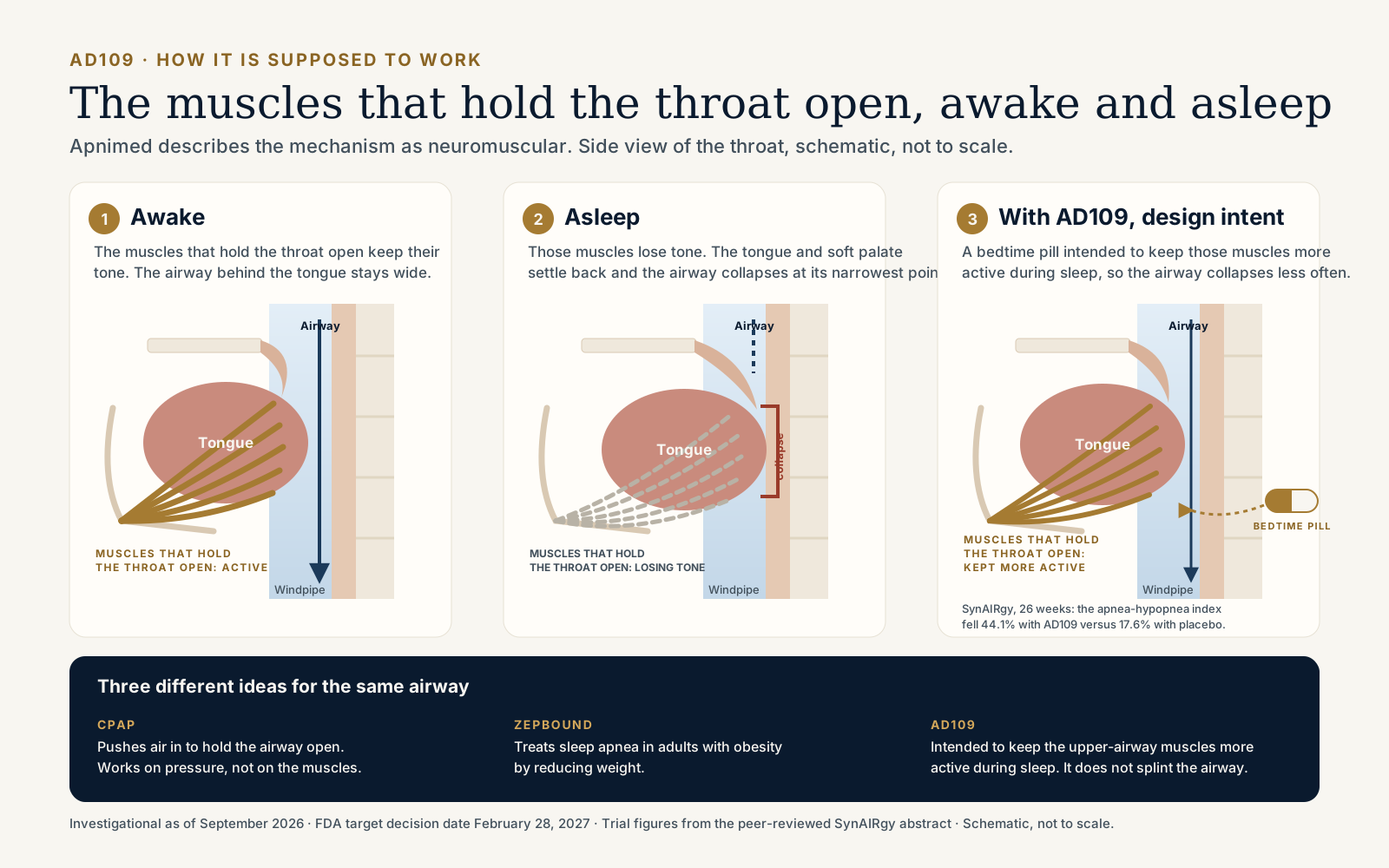
A teaching model of the mechanism Apnimed describes, not a measurement of any airway and not a prediction of how AD109 would work for anyone. The trial measured breathing events, not muscle activity: the apnea-hypopnea index fell 44.1% on AD109 versus 17.6% on placebo at 26 weeks. AD109 is investigational, and nothing here is a dose or a recommendation.
Where does FDA approval stand?
The FDA accepted the New Drug Application on July 14, 2026, with a target decision date of February 28, 2027; AD109 also holds Fast Track designation.
The application rests on two Phase 3 trials, SynAIRgy and LunAIRo, each of which enrolled adults with obstructive sleep apnea who could not tolerate or declined positive airway pressure. Acceptance means the FDA found the application complete enough to review. It is not a signal about the outcome, and Apnimed's own release says there can be no assurance that AD109 will be approved by the target date, or at all. The FDA can also approve with a narrower population or added warnings than the company requested. Nothing about the date guarantees availability in pharmacies on March 1, 2027.
What did the SynAIRgy trial show?
A statistically significant but partial reduction in breathing events and oxygen dips over 26 weeks, with no significant advantage over placebo on fatigue or sleep-impairment scores.
SynAIRgy randomized 646 adults at 69 centers in the United States and Canada, 324 to AD109 and 322 to placebo, for 26 weeks. About half were women, and roughly a third had mild, two fifths moderate, and a quarter severe sleep apnea at entry. The apnea-hypopnea index fell 44.1% on AD109 against 17.6% on placebo; in absolute terms it fell 3.3 events per hour on AD109 while rising 0.7 events per hour on placebo, a difference of 4.0 events per hour. Hypoxic burden, a measure of how much time is spent with low oxygen, fell 44.7% versus 8.5%, and the oxygen desaturation index fell 3.7 events per hour versus a rise of 0.9. Two results deserve as much attention as the headline. Fatigue scores improved 7.4 points on AD109 and 6.2 points on placebo, a difference that did not reach significance, and sleep-impairment scores were also not significantly different. The share of people whose event count fell by at least half was 25.8% on AD109 and 19.8% on placebo, again not significant. The authors concluded that AD109 improved airway obstruction and oxygenation across a broad range of patients; how much people feel better remains an open question.
What are the side effects of AD109?
Dry mouth, insomnia, nausea, and urinary hesitation were the most common, and about one person in five stopped the pill because of side effects.
In SynAIRgy, 70.8% of people on AD109 reported at least one adverse event compared with 46.7% on placebo. Dry mouth affected 35.4%, insomnia 20.6%, nausea 11.4%, and urinary hesitation 8.9%. Discontinuation because of an adverse event was 21.2% on AD109 versus 3.1% on placebo. The abstract reports no serious treatment-related adverse events and describes most events as mild. Those figures come from 26 weeks in people selected for a trial; the FDA label, if one is issued, will list warnings, interactions, and who should not take the medicine, and that document should replace any trial summary, including this one.
How do the company's numbers differ from the published ones?
Apnimed's release reports larger effects because it uses an on-treatment analysis; the peer-reviewed abstract reports the comparison against placebo.
The press release about the publication quotes a 55.6% reduction in the apnea-hypopnea index, a 60.5% reduction in hypoxic burden, and 39.6% of participants reaching at least a 50% reduction, along with 22.3% ending the trial with fewer than five events per hour. The company labels these an on-treatment estimand, which reflects what happened in people who continued the medicine and excludes much of the effect of the 21.2% who stopped. Neither set is wrong, but they answer different questions. When you read a headline about a pill that cuts sleep apnea in half, check which analysis it came from. The table above sets the two side by side.
When will AD109 be available, and what will it cost?
Not before the FDA decides, and no price has been published; the earliest plausible date is after February 28, 2027.
There is no legitimate way to obtain AD109 today outside a clinical trial. If the FDA approves it, Apnimed decides the launch timing, the list price, and any patient-assistance program, and insurers then write their own coverage rules, which for new sleep-apnea medicines have meant prior authorization tied to a sleep study. None of that existed in the company materials we reviewed in September 2026. Websites offering AD109 for sale before an FDA decision are not offering the medicine that was studied. Registered trials are listed on ClinicalTrials.gov under the identifiers in the sources below.
Who was studied, and who was not?
Adults with mild to severe obstructive sleep apnea who could not tolerate or refused positive airway pressure, compared against placebo, for 26 weeks.
That design leaves questions the trials did not answer. AD109 was not compared head to head with CPAP, an oral appliance, hypoglossal nerve stimulation, or Zepbound, so nothing in the data says it works as well as any of them. It was not studied as a replacement in people whose sleep apnea is controlled on CPAP. Central sleep apnea, children, pregnancy, and people with the conditions that trials usually exclude are outside the evidence. Long-term effects beyond half a year, including on blood pressure and heart rhythm with a stimulant-class component, will depend on longer follow-up and on the FDA's review of the full data set, not the abstract.
What should you do now if CPAP is not working for you?
Keep the sleep apnea managed with what exists today, and put the AD109 question on the agenda for the clinician who owns your plan.
Sleep apnea that goes untreated while waiting for a pill is still untreated. Options that are available now include troubleshooting the mask or pressure, a custom oral appliance, positional therapy, hypoglossal nerve stimulation for people who qualify, and Zepbound for adults with obesity and moderate to severe sleep apnea. Which of those fits you is a clinical decision that depends on your sleep study, anatomy, other conditions, and preferences. If you have not had a recent sleep study, that is the first step, because any future prescription for a sleep-apnea medicine will be tied to a documented diagnosis and severity. Do not stop CPAP or another prescribed treatment in anticipation of a medicine that is not yet approved.
How to follow the decision without getting misled
Use the FDA and the company's own announcements, note the date on anything you read, and treat percentages without a source as marketing.
The FDA does not publish a countdown; approval, a delay, or a rejection will appear in Apnimed's announcements and, if approved, in the FDA's drug database and the product label. This page carries its own date. After February 28, 2027, check whether a decision was announced before relying on anything here. Between now and then, the useful facts are stable: the drug is investigational, the published effect is partial, the side effects are common, and the path to it, if it arrives, runs through a diagnosed sleep-apnea plan.
Appointment checklist
Bring four things if you want to ask about AD109
The conversation goes further when it starts from your own results rather than from a headline.
- 1
Your sleep study
The report with the date, test type, apnea-hypopnea index, and severity category. A future prescription will depend on it.
- 2
What has not worked
Specifics about CPAP: hours used, what made it intolerable, whether mask, pressure, or humidity changes were tried, and any oral appliance or surgery history.
- 3
A complete medicine list
Every prescription, over-the-counter medicine, and supplement, so a prescriber can check interactions if AD109 or another medicine becomes an option.
- 4
What you want treatment to change
Daytime sleepiness, a partner's sleep, blood pressure, driving safety, or something else. The trials measured breathing events; you will judge results by how you function.
Common questions
Questions patients ask first
When will AD109 be available?
Not before the FDA decides. The target decision date is February 28, 2027. If approved, Apnimed sets the launch timing, so availability could follow the decision by weeks or months. As of September 2026 no launch date or price has been announced.
What is the new sleep apnea pill called?
The investigational pill in the news is AD109, developed by Apnimed. It combines aroxybutynin and atomoxetine in one bedtime dose. It does not yet have a brand name because it has not been approved.
What are the side effects of AD109?
In the 26-week SynAIRgy trial, dry mouth affected 35.4% of people on AD109, insomnia 20.6%, nausea 11.4%, and urinary hesitation 8.9%. About 21% stopped because of side effects, compared with 3% on placebo. No serious treatment-related adverse events were reported.
Is AD109 FDA approved?
No. The FDA accepted the application for review on July 14, 2026. Acceptance is not approval, and the company's announcement states there is no assurance of approval by the target date, or at all.
What is the best pill for sleep apnea?
As of September 2026 the only medicine with an FDA indication for obstructive sleep apnea is Zepbound, and only for adults with obesity and moderate to severe sleep apnea. No pill is approved to treat sleep apnea in everyone. AD109 is investigational, and the trials did not compare it with any other treatment, so there is no evidence-based answer to which is best.
How much will AD109 cost?
No price has been published. Cost and coverage will be set after any approval, and new sleep-apnea medicines have so far required prior authorization tied to a sleep study. Any site quoting a price for AD109 today is not quoting the studied medicine.
Will AD109 replace CPAP?
The trials enrolled people who could not tolerate or declined positive airway pressure and compared AD109 with placebo, not with CPAP. The published effect was a partial reduction in breathing events. Nobody should stop CPAP for a medicine that is not yet approved, and whether AD109 fits a given person will be a clinical decision after the label exists.
How is AD109 different from Zepbound?
Zepbound is an approved injectable that treats moderate to severe sleep apnea in adults with obesity by reducing weight. AD109 is an unapproved bedtime pill intended to keep airway muscles active during sleep and was studied across body sizes in people who could not use PAP. They have not been compared in a trial.
Can I join an AD109 clinical trial?
Registered studies are listed on ClinicalTrials.gov; the Phase 3 trials that support the application are identified in the sources below. Enrollment status changes, and eligibility is decided by the study team, not by a website.
Authoritative sources
Review the public guidance
- Apnimed press release (July 14, 2026): FDA acceptance of the New Drug Application for AD109
- Strollo PJ Jr et al. SynAIRgy Phase 3 trial of AD109 for obstructive sleep apnea. American Journal of Respiratory and Critical Care Medicine 2026;212(7), published May 18, 2026
- Apnimed press release (May 2026): publication of the SynAIRgy results
- Apnimed: AD109 program overview
- ClinicalTrials.gov: SynAIRgy (NCT05813275)
- ClinicalTrials.gov: LunAIRo (NCT05811247)
- FDA: First Medication Approved for Obstructive Sleep Apnea (Zepbound)
Medically reviewed by Domenico Savatta, MD, FACS on September 5, 2026. Source links support education, not a personal recommendation.